Over 65% of organic search queries now end without an outbound click.
Between Google’s deployment of AI Overviews, the rapid growth of conversational answer engines like Perplexity, and the rollout of ChatGPT Search, the way users consume information on the web has fundamentally shifted. For twenty years, organic marketing focused on a single objective: ranking in the top three blue links on a Search Engine Results Page (SERP).
Today, ranking #1 for an informational query often places your link below an AI-generated synthesis, an interactive widget, and sponsored carousels.
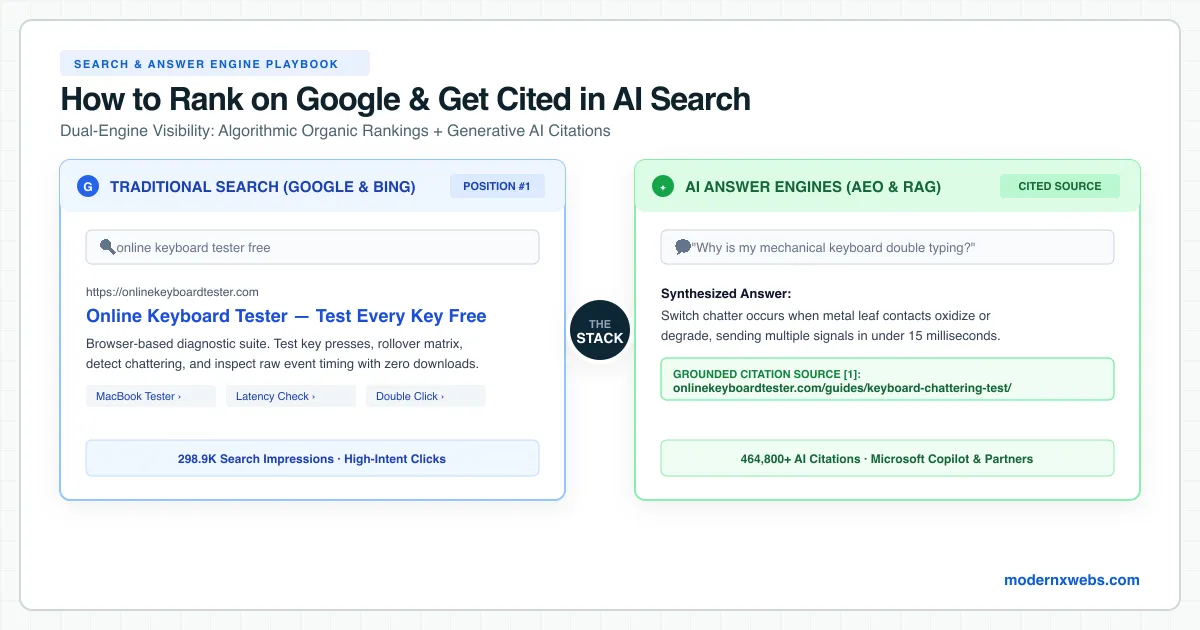
This shift has created two distinct search battlegrounds:
- Traditional Algorithmic Retrieval (SEO): Competing for indexation, organic keyword rankings, and high-intent commercial clicks on Google and Bing.
- Generative Synthesis & Citation (AEO): Becoming the verified primary source that large language models (LLMs) read, extract, and cite when formulating direct answers to conversational prompts.
Most online advice treats these as separate disciplines. Marketers either regurgitate 2018 keyword-stuffing tactics or claim that traditional SEO is dead and only “AI prompts” matter. Both views are incorrect.
AEO does not replace SEO. It sits directly on top of it. An AI search crawler cannot cite a page it cannot render, and an LLM will not trust an entity that has no verifiable digital footprint across the wider web.
This guide provides the complete, engineering-backed playbook for winning both battles. We will break down each of the four pillars, outline exact technical specifications, provide copy-pasteable configuration files, and demonstrate the entire system in action through our case study of Online Keyboard Tester—a platform built from scratch by Modern X Webs that generated 464,800+ AI citations and 298,800+ search impressions in a single 30-day window.
The Four Pillars of Modern Search Visibility
To build a website that consistently captures organic traffic and earns AI citations, you must treat search optimization as a unified stack rather than isolated tactics.
The Four-Pillar Search & Answer Engine Architecture
| Pillar | Core Question | Target System | Primary Outcome |
|---|---|---|---|
| 01. Technical SEO | Can bots reach, crawl, and render your pages without friction? | Googlebot, Bingbot, web scrapers | 100% crawl efficiency, valid indexation, zero rendering errors |
| 02. On-Page SEO | Does your content match the searcher’s intent and semantic context? | NLP ranking algorithms (RankBrain, BERT) | High keyword relevance, high CTR, strong user dwell time |
| 03. Off-Page SEO | Does the broader internet vouch for your domain’s credibility? | PageRank, Knowledge Graph, Entity indexes | Domain trust, topical authority, algorithmic brand confidence |
| 04. AEO & AI Search | Is your content structured so an LLM can extract and cite facts? | RAG pipelines (Perplexity, ChatGPT, AI Overviews) | Direct answer citations, brand recommendations, zero-click visibility |
Notice the strict dependency hierarchy. If Pillar 01 fails, Pillar 02 cannot be indexed. If Pillar 02 is thin or confusing, Pillar 03 will not earn natural links. And if your site lacks Pillars 01 through 03, AI models will ignore your content during retrieval-augmented synthesis.
Let’s examine how to execute each layer step by step.
Technical SEO: The Foundation Everything Else Rests On
Technical SEO represents the code, infrastructure, and server architecture that allow search crawlers and AI bots to parse your site. If your technical layer is broken, excellent writing and PR outreach are completely wasted.
1. Crawlability: Opening the Front Door
Before a search engine can rank your page—or an AI agent can read it—it must discover and crawl the raw resources.
- Robots.txt Architecture: Your
robots.txtfile controls crawler traffic. A frequent catastrophic mistake following site redesigns is leaving staging directives in production (such asDisallow: /). Ensure yourrobots.txtis served at the domain root with a200 OKheader, points directly to your XML sitemap index, and blocks only administrative or duplicate paths. - XML Sitemap Discipline: Submit dynamic, clean XML sitemaps to both Google Search Console and Bing Webmaster Tools. Include only canonical, indexable URLs that return a
200 OKresponse status. Exclude redirects (301s), dead pages (404s), and parameterized filter URLs. For sites exceeding 10,000 URLs, break files into categorized sub-sitemaps (e.g.,sitemap-tools.xml,sitemap-guides.xml). - Eliminate Broken Links and Redirect Chains: When an internal link points to a page that redirects (
Page A -> Page B -> Page C), crawlers waste limited crawl budget on intermediate hops. Use automated audit tools like Screaming Frog to flatten all redirects into direct, single-hop destinations and eradicate internal 404 errors. - Shallow Information Architecture: Maintain a flat site hierarchy. Every key commercial tool, product landing page, or high-value resource should be reachable within three clicks or fewer from the homepage. Deeply buried pages suffer from low crawl frequency and diluted internal PageRank.
2. Indexing: Ensuring Your Content Is Stored
Crawling is merely discovery; indexing is storage. A page that is crawled but not indexed cannot appear in search results or generative AI retrieval.
- Self-Referencing Canonicals: Every indexable URL must declare an explicit, self-referencing canonical tag in the
<head>of the document (<link rel="canonical" href="https://example.com/page/" />). This protects your content from duplicate penalties caused by UTM tracking tags, session parameters, and trailing slash variations. - Audit for Accidental
noindexTags: Verify that production HTML and HTTP response headers do not contain inadvertentnoindexornonemeta directives. Regularly inspect the Pages report in Google Search Console to catch pages marked as “Crawled - currently not indexed” or “Excluded by noindex tag.” - Avoid JavaScript Hydration Traps: Search engines can execute client-side JavaScript, but it requires secondary rendering queues that delay indexing. Furthermore, many AI search bots (like
PerplexityBot) scrape the initial server HTML response and do not execute heavy client-side React or Vue bundles. Ensure your core text, tables, and links are server-side rendered (SSR) or pre-built statically at deploy time.
3. Core Web Vitals & Real-World User Experience
Google officially evaluates Core Web Vitals as a page experience ranking factor. Slow, shifting websites suffer lower rankings and higher bounce rates.
Core Web Vitals Targets for High Search Performance
| Metric | What It Measures | Target Threshold | Primary Engineering Fix |
|---|---|---|---|
| LCP (Largest Contentful Paint) | Loading speed of main content block | ≤ 2.5 seconds | Serve modern WebP/AVIF images, deploy global CDN caching, inline critical CSS |
| INP (Interaction to Next Paint) | UI responsiveness to user clicks/inputs | ≤ 200 milliseconds | Defer third-party scripts, break long main-thread JS tasks into microtasks |
| CLS (Cumulative Layout Shift) | Visual stability while elements render | ≤ 0.1 | Declare explicit width and height on images/videos, reserve ad containers |
4. Mobile-First Architecture & Complete HTTPS
Google predominantly uses the mobile version of your website for indexing and ranking. If your mobile layout hides important explanatory text, eliminates navigation menus, or truncates data tables to save visual space, your desktop rankings will drop accordingly. Maintain absolute content and metadata parity between desktop and mobile templates.
Additionally, full HTTPS encryption is non-negotiable. Ensure valid SSL certificates, resolve mixed-content warnings, and enforce automated HTTP-to-HTTPS permanent redirects at the server level.
On-Page SEO: Telling Search Engines What Your Page Is About
Once search bots can seamlessly crawl your infrastructure, on-page optimization tells them exactly what search queries your content answers, how authoritative your perspective is, and why your page provides superior value over competitors.
1. Intent Matching: The Foundation of Modern Content
In modern search, keyword density is obsolete. What dictates rankings is search intent satisfaction. Google’s NLP systems (RankBrain, BERT, and Gemini-based classifiers) categorize user queries into four fundamental buckets:
- Informational: “How do mechanical keyboard switches work?” (Searcher needs a clear, educational explanation).
- Navigational: “Keychron support downloads” (Searcher is looking for a specific domain or portal).
- Commercial Investigation: “Best low profile mechanical keyboards 2025” (Searcher is evaluating options and comparing specs).
- Transactional: “Buy Cherry MX Red switches pack of 110” (Searcher has their credit card ready to complete a purchase).
Before drafting a single paragraph, perform a manual Google search for your target term. If the entire top five consists of interactive tools, publishing a 4,000-word history essay will fail to rank regardless of how well it is written. Match the dominant structural format the search engine has already determined users want.
2. Title Tags and Meta Descriptions That Drive CTR
Your <title> tag is the strongest on-page relevance signal you control, while also serving as your primary digital billboard.
- Front-Load the Core Keyword: Place your primary search phrase as close to the beginning of the title tag as possible.
- Keep Within Character Boundaries: Keep title tags between 50 and 60 characters (under 600 pixels) to avoid awkward SERP truncation.
- Optimize for Click-Through Rate (CTR): Google’s internal ranking systems (such as the NavBoost click-validation engine revealed in the 2024 API documentation leak) heavily evaluate user interaction signals. A title tag that captures a 9% CTR will outrank a sterile, keyword-stuffed title that captures a 2% CTR. Use compelling brackets, specific years, or concrete metrics:
- Ineffective:
Keyboard Testing Tool - Test Keyboards Online Free - High-Converting:
Online Keyboard Tester: Test Every Key Free in Your Browser
- Ineffective:
- Meta Descriptions as Conversion Copy: While meta descriptions are not a direct algorithmic ranking factor, they dictate SERP click-through rates. Keep them between 120 and 155 characters, provide an immediate value proposition, and close with an active directive.
3. Clear Semantic Heading Hierarchy (H1 → H2 → H3)
Search engines and AI web scrapers parse HTML headings to construct an outline of your document.
- A Single H1 Per Document: Every page must feature exactly one
<h1>that explicitly states the primary subject of the page. - Logical Subtopics in H2s: Break your content into distinct thematic chapters using
<h2>elements. Use natural semantic keyword variations rather than repeating the exact same phrase. - Question-Based H2s for Rich Snippets: Formatting subheadings as explicit questions (e.g.,
## What Causes Mechanical Keyboard Chattering?) allows your content to be harvested by Google’s “People Also Ask” algorithm and generative AI answer blocks. - Granular Details in H3s: Nest specific steps, tool lists, or sub-specifications under
<h3>elements to maintain rigorous structural hierarchy.
4. E-E-A-T: Demonstrating Unmistakable Real-World Experience
Google’s Search Quality Rater Guidelines prioritize Experience, Expertise, Authoritativeness, and Trustworthiness (E-E-A-T). Following the Helpful Content algorithm rollouts, generic content manufactured purely to capture search volume is routinely demoted.
To establish authentic E-E-A-T:
- Prove Firsthand Experience (The First E): Include original photography, live product screenshots, proprietary testing benchmarks, or real client case metrics. Generic stock images signal zero actual product interaction.
- Verifiable Author Credentials: Include a clear author byline linked to an dedicated author page detailing real-world industry background, published papers, or relevant professional engineering experience.
- Transparent Citations: Attribute factual assertions to authoritative third-party publishers, peer-reviewed studies, or official documentation. Outbound links to high-relevance sources validate your editorial integrity.
5. High-Velocity Internal Linking
Internal links distribute authority (PageRank) from your high-traffic pages to newer or deeper commercial assets.
Every new article or tool page should receive at least 3 to 5 contextual internal links from older, relevant content on your site upon publication. Always use descriptive, keyword-rich anchor text that explains the destination. Avoid generic anchor text like “click here” or “read more,” which passes zero semantic context to web crawlers.
Off-Page SEO: Building Trust Beyond Your Own Site
On-page SEO tells search engines what your business does. Off-page SEO proves whether anyone else in your industry respects your work enough to endorse it.
1. Backlink Quality vs. Volume
External hyperlinks remain a core ranking factor in Google’s algorithm. However, the days of acquiring hundreds of directory links or using Private Blog Networks (PBNs) are long over. Search engines aggressively discount low-effort, irrelevant links.
A single editorial backlink from a respected, high-traffic industry publication (such as Tom’s Hardware, PC Gamer, or The Verge in the hardware space) carries more ranking weight than 500 low-tier links from unmoderated bookmarking directories.
Link Acquisition: Effective Strategies vs. High-Risk Tactics
| Acquisition Strategy | How It Works | Risk Level | Long-Term Value |
|---|---|---|---|
| Engineering as Marketing (Free Tools) | Build a free calculator, validator, or interactive utility that solves an immediate problem. | Zero | Highest: Naturally earns recurring links from forums, blogs, and tutorials. |
| Digital PR & Proprietary Data | Publish original surveys, industry research reports, or unique usage statistics. | Zero | Very High: Journalists cite original data points as primary sources. |
| Broken Link Building | Identify dead 404 links on relevant industry resource pages and pitch your updated asset. | Low | Moderate: High conversion rate because it fixes a genuine webmaster issue. |
| Paid Link Networks / PBNs | Purchasing placements on private blogs or link-selling syndicates. | Extreme | Negative: Triggers algorithmic link spam demotions and manual action penalties. |
2. The Power of “Engineering as Marketing”
The single most sustainable way to build high-authority backlinks without sending thousands of cold outreach emails is building free utility tools.
When you provide a browser-based utility that solves an everyday problem—such as testing a broken keyboard key, converting an image format, or calculating SaaS churn—people link to it organically. Tech enthusiasts share it in Reddit troubleshooting threads. Hardware manufacturers recommend it on community forums. Reviewers link to it in YouTube video descriptions.
This organic linking flywheel generates the cleanest, most authoritative backlink profile possible, providing the domain authority necessary to lift all other content on your website.
3. Entity SEO and Digital Brand Footprint
Both Google and AI answer engines evaluate your business as an Entity—a recognized object in their knowledge graph with defined relationships, attributes, and consensus trust.
- Consistent Brand Signals: Maintain identical brand naming, business categorization, and executive leadership profiles across LinkedIn, Crunchbase, GitHub, and relevant industry registries.
- Unlinked Brand Mentions: Search algorithms monitor mentions of your brand across high-authority news outlets and community hubs, even when an active hyperlink is absent. AI search engines heavily factor in third-party brand sentiment and conversational consensus.
- Community Footprint: Google surfaces community discussions from platforms like Reddit and Quora prominently in search results. Authentic participation in industry discussions establishes organic brand recognition that algorithms track as real-world entity validation.
AEO: How to Get Your Website Cited in AI Search Results
Traditional SEO wins you a ranked blue link on a results page. Answer Engine Optimization (AEO) wins you a direct citation inside the synthesized answer generated by AI systems like ChatGPT Search, Perplexity, Google AI Overviews, and Microsoft Copilot.
How Modern AI Engines Source Their Answers
Different answer engines possess distinct crawling habits and data preferences:
- Google AI Overviews (AIO): Deeply integrated with Google’s core search index. A page must possess solid traditional ranking signals to be eligible for selection. Prefers clear Q&A formatting, structured lists, and explicit schema markup.
- Perplexity AI: Operates on an aggressive, real-time web crawler (
PerplexityBot). Relies heavily on fresh, technically structured web sources, authoritative documentation, and community consensus hubs (especially Reddit). Cites sources frequently—often 5 to 10 distinct citations per answer. - ChatGPT Search: Combines real-time web crawling (
OAI-SearchBot) with underlying knowledge graph entity verification. Heavily favors established brand entities, recognized technical authorities, and clean markdown documentation. - Microsoft Copilot: Leverages Bing’s search infrastructure, ranking algorithms, and indexation models. Relies heavily on structured schema and verified site data.
Step 1: Open the Door — Configure Your robots.txt for AI Crawlers
The single most common reason websites fail to appear in AI answers is that their engineering teams accidentally blocked AI crawlers in robots.txt.
AI search crawlers use different user-agent strings from standard web indexers. Furthermore, AI companies maintain distinct bots for training models versus live search retrieval. You can safely block training scrapers while keeping real-time citation crawlers open.
Add this explicit configuration to your production robots.txt:
# ==============================================================================
# AI SEARCH & CITATION CRAWLERS (PERMITTED)
# These bots fetch real-time data to display citations in search results.
# ==============================================================================

# OpenAI Search & Real-Time Retrieval (ChatGPT Search)
User-agent: OAI-SearchBot
Allow: /

User-agent: ChatGPT-User
Allow: /

# Perplexity AI Live Search Crawler
User-agent: PerplexityBot
Allow: /

User-agent: Perplexity-User
Allow: /

# Anthropic Claude Search Citations
User-agent: Claude-SearchBot
Allow: /

# Google Gemini & Extended AI Features
User-agent: Google-Extended
Allow: /

# Microsoft Bing & Copilot
User-agent: Bingbot
Allow: /

# ==============================================================================
# OPTIONAL: MODEL TRAINING SCRAPERS (BLOCK IF DESIRED)
# Blocking these prevents LLM training without hurting search citations.
# ==============================================================================
User-agent: GPTBot
Disallow: /

User-agent: ClaudeBot
Disallow: /

# ==============================================================================
# STANDARD CRAWLER DIRECTIVES
# ==============================================================================
User-agent: *
Allow: /

Sitemap: https://www.yourdomain.com/sitemap.xmlStep 2: Structure Content for “Answer-First” Extraction
To make your content the preferred choice for RAG retrieval engines, format your body text using the Answer-First Method:
- The 50-Word Direct Answer Rule: Place an unambiguous, definitive 2-to-3 sentence answer directly beneath every major question-based H2 or H3 heading. Do not open with introductory throat-clearing (“Throughout human history, typing has been important…”). Give the exact answer immediately, then provide background context. AI engines lift these neat answer blocks directly into their output.
- Conversational Question Headings: Users type natural questions into ChatGPT and Perplexity (“How do I fix keyboard chatter?” or “What is the difference between ghosting and rollover?”). Use exact conversational questions as your headings to ensure high semantic cosine-similarity during vector retrieval.
- Statistical & Factual Density: Academic research on Generative Engine Optimization (GEO) demonstrates that adding specific statistics, concrete benchmarks, and attributed citations increases an AI model’s likelihood of citing a passage by up to 40%. Vague assertions get discarded; precise numbers get quoted.
- Scannable Semantic HTML Lists: Use ordered (
<ol>) and unordered (<ul>) lists for sequential instructions or multi-part explanations. LLMs parse structured list nodes far more reliably than dense walls of prose. - Crawlable Comparison Tables: When comparing products, specifications, or workflows, use clean HTML
<table>elements with semantic<th>,<tr>, and<td>tags. AI models frequently extract entire tables directly into search syntheses. Avoid image screenshots of tables or CSS-grid card replacements.
Step 3: Implement Machine-Readable Schema Markup
Structured data provides unambiguous, machine-readable facts that allow LLMs to bypass language ambiguity.
Primary Schema Markup Types for AI Search Visibility
| Schema Type | Why It Matters for AI Engines | Primary GEO Impact | Priority |
|---|---|---|---|
FAQPage |
Explicitly maps questions to definitive answers in structured JSON. | Provides pre-packaged extraction chunks for conversational prompts. | Critical |
Article |
Defines canonical author, publisher, publication date, and headline. | Verifies content freshness, editorial credentials, and E-E-A-T. | Critical |
Organization |
Defines company entity and populates social/business sameAs arrays. |
Disambiguates your brand entity across knowledge graphs. | Critical |
HowTo |
Breaks procedural workflows into distinct, numbered operational steps. | Enables AI agents to construct step-by-step instructional responses. | High |
BreadcrumbList |
Communicates page position and hierarchical taxonomy. | Helps LLMs understand thematic categories and topical relationships. | Moderate |
Always serve schema markup via server-side rendered JSON-LD in the <head> of the page. Client-side script tags injected after hydration are frequently missed by fast AI scrapers.
<!-- Example of High-Extractability FAQPage JSON-LD -->
<script type="application/ld+json">
{
  "@context": "https://schema.org",
  "@type": "FAQPage",
  "mainEntity": [
    {
      "@type": "Question",
      "name": "What is the difference between keyboard ghosting and limited rollover?",
      "acceptedAnswer": {
        "@type": "Answer",
        "text": "Keyboard ghosting occurs when an unpressed key is erroneously registered due to electrical column-row matrix bridging. Limited rollover (such as 2-key or 6-key rollover) occurs when intended physical keypresses fail to register because the hardware matrix cannot process additional simultaneous inputs. Modern mechanical gaming keyboards solve this using individual diodes per switch to achieve Full N-Key Rollover (NKRO)."
      }
    }
  ]
}
</script>
Step 4: The Truth About the llms.txt Standard
In late 2024, the developer community proposed llms.txt—a standard inspired by robots.txt where a website hosts a curated, markdown-formatted map of its core offerings and technical documentation at yourdomain.com/llms.txt.
- What it does: It provides autonomous AI coding assistants, browser agents, and developer research tools with a lightweight, clean index of your site’s content, completely stripped of navigation menus, advertising banners, and complex CSS stylesheets.
- What it does NOT do: Google, OpenAI, and Perplexity have officially clarified that
llms.txtis not an algorithmic ranking or citation signal. Placing anllms.txtfile on your server will not magically force ChatGPT Search or Google AI Overviews to cite your website. - Our Recommendation: Implement an
/llms.txtfile. It takes twenty minutes to configure, provides clean discovery for autonomous developer agents, and positions your platform well for future agentic protocols. However, never treat it as a substitute for solid content architecture, clean server HTML, and real entity authority.
Step 5: How to Track and Measure AEO Performance
Traditional search metrics (like keyword average position) fail to capture AI search performance because of zero-click answer synthesis. To track your AEO footprint effectively:
- Monthly Manual Prompt Audits: Assemble a spreadsheet of 25 to 50 conversational, high-intent prompts your target customers ask. Run these queries monthly across ChatGPT Search, Perplexity, and Google AI Overviews. Track three data points:
- Is your brand or tool mentioned by name?
- Does the AI include a clickable citation link back to your domain?
- Is the synthesized information accurate?
- Monitor AI Referral Paths in Web Analytics: Look for referral sessions from domains such as
chatgpt.com,perplexity.ai, andandroid-app://com.openai.chat. While traffic volumes will be smaller than traditional Google organic clicks, conversion rates on AI referral traffic are often 3x to 5x higher because the prospect has already had their problem evaluated and validated by the AI before clicking. - Bing Webmaster Tools AI Performance Dashboard: Bing provides an official AI Performance reporting module within Webmaster Tools. It tracks total citation counts, average cited pages per day, and the specific grounding queries that caused Microsoft Copilot to reference your site.
- Track Branded Search Volume Uplift: When an AI answer engine recommends your brand, users often open a fresh browser tab and search your brand name directly. An upward trend in branded search queries within Google Search Console is a primary downstream indicator of successful AEO traction.
Case Study: How We Got 464,800+ AI Citations for Online Keyboard Tester
To see what happens when all four pillars are executed together, examine the real-world growth of Online Keyboard Tester (onlinekeyboardtester.com).
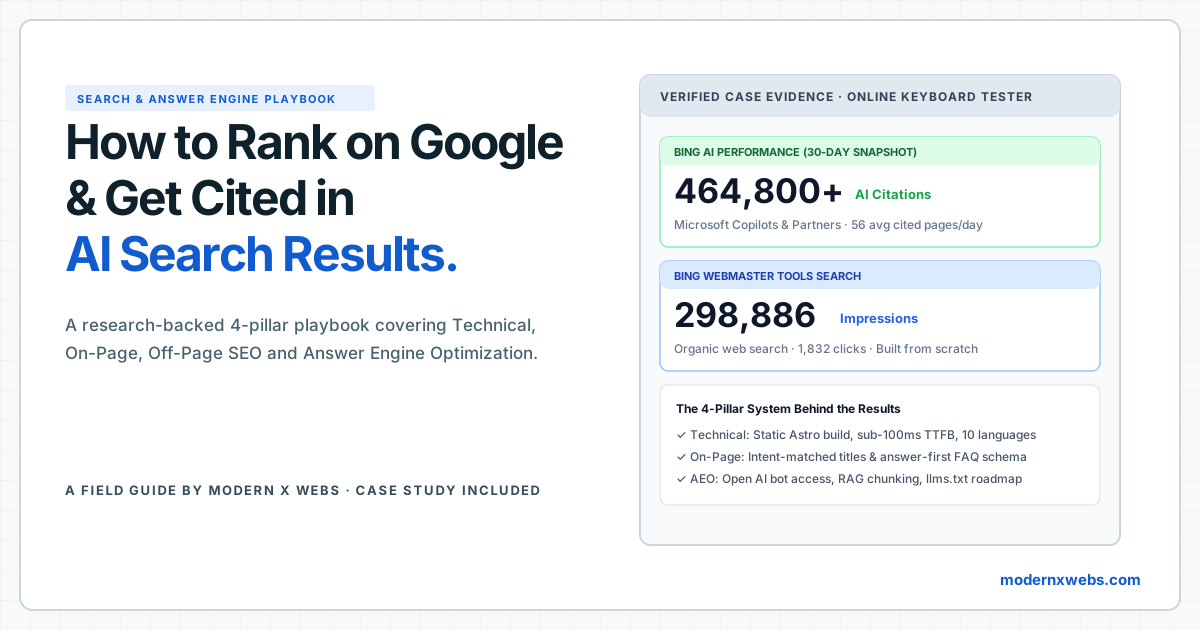
Figure 1: Verified 30-day search and AI performance evidence for Online Keyboard Tester, captured from Bing Webmaster Tools and approved for publication.
01. The Challenge & Concept
Modern X Webs built Online Keyboard Tester from scratch. The objective was to design a clean, zero-friction, browser-based hardware diagnostic platform that allows gamers, engineers, and everyday computer users to test physical keyboard keys, detect switch chatter, evaluate latency, and inspect keystroke events without installing desktop software.
The keyboard testing space is highly competitive, dominated by legacy tools that have accumulated backlinks for over a decade. Winning search visibility required out-executing competitors across technical architecture, multilingual accessibility, and machine-readable data formatting.
02. Technical Architecture & Engineering
- Static Astro Engine: We engineered the platform using Astro with static build output. The entire user interface and testing canvas load instantly with zero client-side hydration bloat. Initial server response times (TTFB) routinely clock in under 80ms via Cloudflare’s global edge network.
- 10-Language Multilingual Matrix: We localized the interactive testing suite across 10 global languages (
en,es,ja,fr,de,pt,it,id,zh-Hans,zh-Hant). Every localized page features fully synchronized bidirectionalhreflangheaders and self-referencing canonicals, eliminating duplicate content penalties. - Open AI Crawler Directives: We explicitly configured
robots.txtto permitOAI-SearchBot,PerplexityBot, andGoogle-Extended. We verified that Cloudflare WAF firewall rules permitted clean automated access. - Server-Rendered Schema Suite: Every page includes server-rendered JSON-LD schema matching visible text, including
WebApplication,BreadcrumbList, and comprehensiveFAQPageentities.
03. On-Page & AEO Content Architecture
Beneath the interactive testing utility, we structured every supporting guide around high-intent conversational diagnostics:
- Dedicated landing pages targeting specific hardware issues (e.g., MacBook keyboard testing, switch chattering diagnostics, mouse double-click testing).
- Every technical guide opens with a definitive, 40-word explanation of the physical failure mechanism (e.g., explaining copper leaf oxidation in mechanical switches).
- Diagnostic steps are broken into semantic HTML ordered lists and tables comparing switch actuation characteristics.
- We published an
/llms.txtand/llms-full.txtknowledge base outlining tool capabilities, test parameters, and citation guidelines.
04. The Verified Results
By combining a blazing-fast utility tool with structured, answer-first content, the website earned extraordinary visibility across both traditional search and AI answer engines.
According to verified data from Bing Webmaster Tools (for the 30-day period ending late October 2026, published with permission):
- 298,886 Search Impressions on Bing Web search.
- 1,832 Direct Organic Clicks from high-intent hardware diagnostic queries.
- 464,800+ AI Citations generated across Microsoft Copilots and partner answer engines.
- 56 Average Cited Pages Per Day displayed inside AI-synthesized responses.
- 698 Distinct Grounding Queries that triggered Online Keyboard Tester as a cited reference source.
Crucially, 230,073 of those citations came from the simplified Chinese search query 键盘测试 (keyboard test)—proving that our multilingual technical architecture allowed international AI search queries to locate, trust, and cite the platform seamlessly.
The platform spent zero dollars on advertising and zero dollars buying backlinks. The search impressions and AI citations were the direct result of executing all four pillars cleanly.
Your Priority Action Plan
Do not attempt to execute every tactic simultaneously. Follow this sequenced implementation schedule:
0 of 21 checks complete
Completion records your review; it is not an automated audit.
Want All Four Pillars Engineered for Your Website?
Building a website that dominates both traditional search engine rankings and generative AI citations requires deep technical discipline, rigorous content architecture, and ongoing entity development.
At Modern X Webs, we design, build, and optimize high-performance websites and digital platforms engineered specifically for modern search visibility. We don’t sell vague SEO retainers or generic AI copywriting; we build high-speed web infrastructure, interactive utilities, and authoritative content architectures that deliver measurable, verifiable results.
If you are planning to launch a new platform, redesign an existing web presence, or future-proof your business against the AI search transition:
- Explore our verified case studies to see our production work in detail.
- Review our dedicated organic SEO services and web development capabilities.
- Or reach out directly to schedule a technical architecture consultation for your brand.
If you found this guide valuable, share it with a founder or marketing team who is still relying on 2018 keyword checklists to solve 2026 search challenges.
COMMON QUESTIONS
Frequently asked questions.
What is answer engine optimization (AEO)?
Answer engine optimization (AEO) is the process of structuring and formatting website content so that AI engines—including ChatGPT Search, Perplexity, Google AI Overviews, and Microsoft Copilot—can reliably extract factual answers and cite your URLs in synthesized responses. While traditional SEO focuses on driving clicks from ranked blue links, AEO focuses on extraction, factual grounding, and authoritative source citation.
How is AEO different from traditional SEO?
Traditional SEO optimizes for ranking positions on search engine result pages (SERPs) where users scan listings and click through to websites. AEO optimizes for Retrieval-Augmented Generation (RAG) pipelines where an AI scraper extracts concise text chunks to construct a direct answer. AEO does not replace SEO; it builds upon technical health and entity trust. A site with crawl blocks or slow rendering will not earn AI citations regardless of content quality.
How do I get my website cited in ChatGPT Search and Perplexity?
To earn citations in ChatGPT Search and Perplexity, ensure your robots.txt allows OAI-SearchBot and PerplexityBot, structure content with answer-first paragraphs beneath question-based H2/H3 headings, provide verifiable statistics and dates, publish server-rendered FAQPage and Article JSON-LD schema, and establish off-site entity mentions across credible third-party platforms like industry directories, Reddit, and trusted publications.
Which AI crawlers should I allow in my robots.txt file?
To maximize AI search visibility without giving away rights to general model training, allow OAI-SearchBot (ChatGPT Search citations), ChatGPT-User (ChatGPT direct web browsing), PerplexityBot (Perplexity AI search), Claude-SearchBot (Anthropic search citations), and Google-Extended (Google Gemini and AI Overviews). If you wish to prevent your proprietary text from being used in foundation model training, you can separately disallow GPTBot and ClaudeBot while keeping search retrieval bots open.
Does publishing an llms.txt file help with search rankings?
An llms.txt file is a markdown-formatted directory placed at your root domain to provide AI tools a clean summary of your key pages. Representatives from major search providers, including Google and OpenAI, have confirmed that llms.txt is not currently an algorithmic ranking or citation factor. It is a low-effort, forward-compatible developer asset that assists LLM agents with clean context, but it cannot substitute for clean HTML, fast TTFB, and strong topical authority.
What schema markup types are most effective for AI search citations?
The most impactful schema types for AI citation are FAQPage (enabling direct question-and-answer extraction), Article with explicit author and publisher entities (verifying E-E-A-T credentials and freshness), and Organization with populated sameAs links (anchoring your brand entity across knowledge graphs). HowTo markup provides high utility for procedural queries. Schema must be rendered server-side in clean JSON-LD rather than injected client-side via JavaScript.
What is technical SEO and why must it come before content optimization?
Technical SEO represents the infrastructural foundation that allows search engines and AI scrapers to crawl, render, and index web pages. If a website suffers from accidental noindex tags, broken redirect chains, slow response times, or heavy client-side JavaScript rendering barriers, crawlers cannot parse the underlying content. Without technical health, on-page content relevance and off-page backlink equity cannot be evaluated.
How long does it take for a new website to rank and earn AI citations?
Traditional Google rankings for competitive commercial queries typically take between three to six months to mature as crawlers discover internal links and build trust. AI answer engines like Perplexity, however, can index and cite technically accessible, well-structured content within days of publication if the page resolves a specific query with high factual accuracy. Building sustained, broad AI visibility across major queries requires ongoing entity development over several months.
Can a new or small business website compete against large brands in AI search?
Yes. While traditional search often skews toward high Domain Rating (DR) legacy publications, AI search engines evaluate information gain, factual conciseness, and structural extractability. A focused niche website that provides clear, unambiguous answers, verified data, and valid schema often gets cited over large legacy media sites whose answers are buried beneath thousands of words of promotional fluff, ads, and intrusive scripts.
What role does E-E-A-T play in AI answer engine citations?
Experience, Expertise, Authoritativeness, and Trustworthiness (E-E-A-T) serve as primary criteria for AI search engines trying to prevent hallucinations. AI retrieval models cross-reference claims against web consensus and prioritize sources with verified author credentials, first-party data, transparent business disclosures, and clean external citations. Demonstrating firsthand experience through original testing or proprietary data significantly elevates citation probability.
THE RESEARCH BEHIND THE ARTICLE
Sources & methodology.
Recommendations in this playbook are drawn from Google Search Central documentation, official OpenAI and Microsoft webmaster specifications, published Generative Engine Optimization research, and Modern X Webs' direct production deployment on Online Keyboard Tester, which generated 298,886 search impressions and 464,800+ AI citations in a verified 30-day period.
Browse all 9 references
- Creating helpful, reliable, people-first contentGoogle Search Central
- Core Web Vitals and their thresholdsweb.dev
- Introduction to robots.txtGoogle Search Central
- FAQPage structured dataGoogle Search Central
- Article structured dataGoogle Search Central
- OpenAI web crawler documentationOpenAI
- Understand how Bing AI Performance is measuredMicrosoft Bing Webmaster Tools
- Google E-E-A-T and Search Quality Rater GuidelinesGoogle Search Central
- Mobile-first indexing best practicesGoogle Search Central