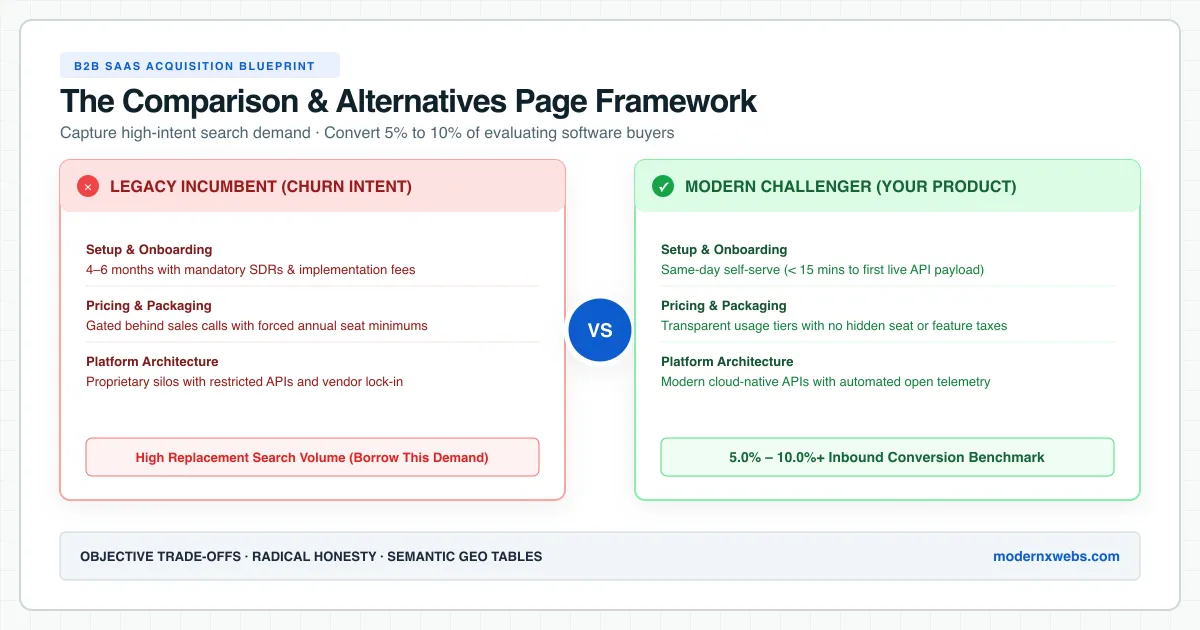
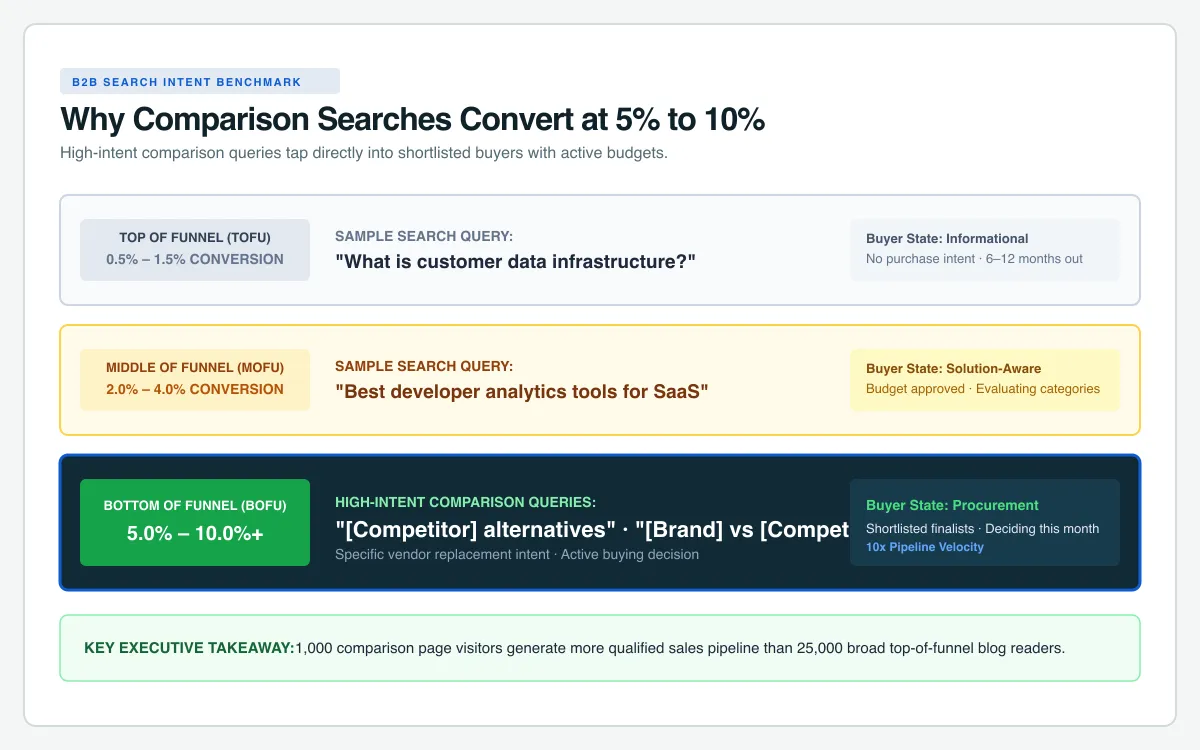
In B2B software marketing, top-of-funnel blog posts that explain broad concepts typically convert between 0.5% and 2% of organic visitors. In contrast, bottom-of-funnel (BoFU) competitor comparison pages—such as [Competitor] alternatives and [Brand] vs [Competitor]—consistently convert at 5% to 10%.
The reason is simple: prospects searching for alternative software have already diagnosed their problem, secured a corporate budget, and shortlisted vendors. They are not asking “What is customer data infrastructure?” They are asking “Should we switch from Segment to RudderStack, and how much downtime will our engineering team endure?”
If your company does not build a dedicated, objective comparison page, third-party review aggregators like G2, Capterra, or the competitors themselves will control the narrative.
This field guide outlines the exact wireframe, copywriting psychology, technical SEO architecture, and legal compliance safeguards required to build high-converting B2B SaaS comparison assets.
Download the B2B SaaS comparison page blueprintTXT · Complete wireframe structure, copywriting prompts, legal review checklist, and JSON-LD schema templateWhy comparison pages convert at 5–10%
When evaluating software investments, executive buyers experience severe decision anxiety. Gartner research consistently reveals that modern enterprise buying groups spend only 17% of their total purchase journey meeting with potential suppliers, spending the remaining 83% conducting independent digital research.
Comparison pages act as a high-velocity decision bridge during this independent research phase. Depending on your brand’s maturity, they serve two distinct commercial functions:
- Borrowing Demand (Offensive Strategy): For early-stage and high-growth challenger software, your own brand may only receive 200 monthly searches, while an established legacy incumbent commands 50,000 monthly brand queries. By targeting
[Incumbent] alternativesorBest [Incumbent] alternatives for [Industry], you capture buyers actively fleeing the incumbent’s pricing hikes, legacy complexity, or poor customer support. - Defending Brand Equity (Defensive Strategy): Once your brand achieves market traction, prospective clients will inevitably compare your product to existing vendors (
[Your Brand] vs [Competitor]). Controlling this search destination ensures prospects receive an accurate, verified breakdown of your strengths rather than a competitor’s slanted sales deck.
When we engineer B2B SaaS SEO strategies at Modern X Webs, bottom-of-funnel comparison architecture is often the fastest route to attributable pipeline revenue. It bypasses months of top-of-funnel content nurturing and connects search visibility directly to product demos and self-serve trials.
The 4 fatal mistakes that kill comparison credibility
Most B2B SaaS comparison pages fail because marketing teams approach them as aggressive sales propaganda rather than objective buying guides. Sophisticated buyers immediately spot dishonest positioning. Avoid these four common traps:
1. The “Wall of Green Checkmarks”
The fastest way to destroy buyer trust is a feature comparison table where your product receives a solid column of green checkmarks (✅) while the rival tool receives a solid column of red crosses (❌).
B2B buyers know that enterprise software involves trade-offs. If your competitor has 1,000 employees and an $80 million ARR run-rate, claiming they have zero capabilities makes your brand look dishonest and insecure. High-converting pages openly acknowledge where the competitor excels.
2. The Feature Parity Trap
Listing 45 minor technical features (e.g., “Supports dark mode”, “Exports to CSV”) creates cognitive fatigue. Competitors can copy cosmetic features in a single development sprint.
Decisions are rarely made on minor checklist items; they are made on architectural philosophy, integration speed, data governance, and pricing predictability. Focus your page on the five pivotal capabilities that actually shape day-to-day operations.
3. Aggressive Mudslinging and Derogatory Copy
Mocking a rival product or claiming their software is “broken and unusable” not only repels professional buyers—it exposes your company to commercial litigation.
Courts and regulatory bodies (including the FTC in the U.S. and the ASCI in India) distinguish between acceptable commercial comparison and unlawful product disparagement. Maintain a measured, analytical, engineering-first tone.
4. Stale Information and Outdated Pricing
SaaS products iterate weekly. If your comparison page states that a competitor lacks single sign-on (SSO) or native webhooks when they released that functionality six months ago, your page loses all authority. Furthermore, making false negative claims regarding a competitor’s current product can invalidate your trademark fair use defense.
The 8-part high-converting comparison wireframe
To convert analytical buyers, a comparison page must progress through a deliberate psychological journey: acknowledge the buyer’s evaluation, provide an immediate summary, disqualify unfit prospects, prove workflow superiority, and provide a low-risk migration bridge.
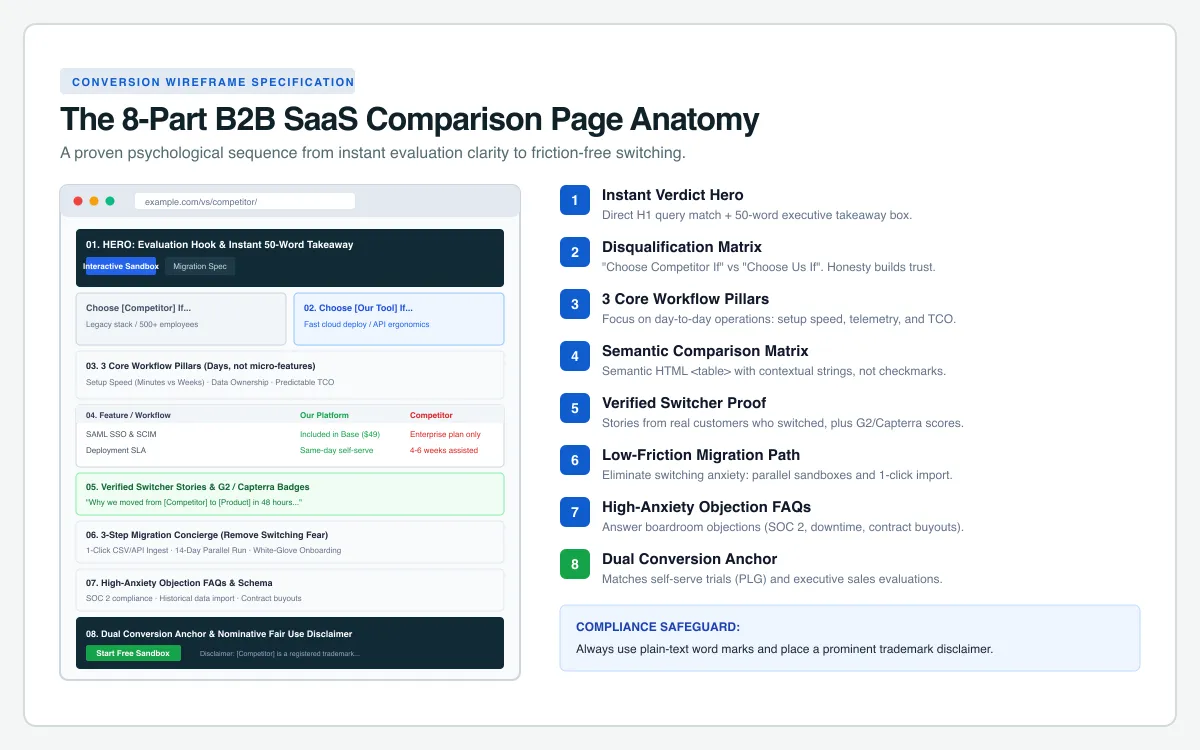
01. The Above-the-Fold Hero & Instant Verdict
Address the evaluation head-on in your H1. Avoid clever brand metaphors; use the exact search terminology your prospects typed into Google.
- High-Intent H1 Formula: “Looking for a [Competitor] alternative built for agile engineering teams?”
- The 50-Word Executive Takeaway Box: Busy executives and search crawlers should not have to scroll 3,000 pixels to find your conclusion. Place a high-contrast takeaway box directly below the subhead:
The Quick Take: Choose [Competitor] if you require deep legacy SAP integrations and have an in-house administrative team to manage complex configurations. Choose [Our Product] if your priority is same-day self-serve deployment, transparent usage-based pricing, and native modern webhooks.
- Dual Conversion Action: Offer a primary high-intent action (e.g., “Explore the Interactive Sandbox” or “Book a Migration Call”) paired with a zero-commitment secondary option (e.g., “View 3-Minute Product Tour”).
02. The “Who Is Each Tool For?” Disqualification Matrix
Counter-intuitively, the most effective way to sell your software is to explicitly state who should not buy it.
Present two clear side-by-side cards:
| When [Competitor] is the better choice | When [Our Product] is the better choice |
|---|---|
| Your organization requires on-premises bare-metal installation. | Your engineering team prioritizes modern cloud-native architectures. |
| You have a dedicated full-time systems administrator to build custom workflows. | You need non-technical team members to launch automated workflows in hours. |
| You require multi-year procurement contracts negotiated through enterprise SDRs. | You prefer transparent monthly billing, instant credit card checkout, and no seat penalties. |
When you openly state that the competitor is better suited for certain enterprise or legacy requirements, buyers immediately believe your claims regarding your own platform’s strengths. Radical honesty creates pricing and positioning power.
03. Three Deep-Dive Workflow Differentiators
Move away from disjointed feature bullets and structure this section around three operational workflow stories. Show how your product actually changes a team’s daily routine:
- Time-to-Value & Setup Friction: Compare the onboarding journey. Does the competitor require four mandatory onboarding calls and an implementation fee, while your product allows engineers to push their first API payload within ten minutes? Show side-by-side workflow diagrams.
- Architectural Ergonomics & Data Ownership: Address data sovereignty. Does the competitor trap data inside closed proprietary formats, while your platform offers automated daily S3 exports and zero-lock-in JSON APIs?
- True Cost of Ownership (TCO): Highlight packaging traps. Contrast transparent, usage-based tiers against the competitor’s practice of gating essential security features (like SAML SSO or audit logs) behind a 300% enterprise price increase.
04. The Scannable Comparison Matrix
Your comparison table must be engineered for scannability and technical search compliance. Never embed tables as images, and avoid complex JavaScript cards that render blank in text browsers.
Ensure every cell contains contextual clarity:
<!-- Example of contextual, crawlable table structure -->
<table>
<caption>Core Capability Comparison: Modern X vs Legacy Incumbent</caption>
<thead>
<tr>
<th scope="col">Evaluation Criteria</th>
<th scope="col">Our Platform</th>
<th scope="col">Competitor Tool</th>
</tr>
</thead>
<tbody>
<tr>
<th scope="row">Deployment Speed</th>
<td>Same-day self-serve (< 15 mins)</td>
<td>3–6 weeks with mandatory professional services</td>
</tr>
<tr>
<th scope="row">SAML SSO & SCIM</th>
<td>Included in standard Pro tier ($49/mo)</td>
<td>Gated behind Enterprise plan (Custom quote)</td>
</tr>
<tr>
<th scope="row">API Rate Limits</th>
<td>10,000 requests / min across all tiers</td>
<td>1,000 requests / day on starter tiers</td>
</tr>
</tbody>
</table>05. Verified Social Proof and Switcher Stories
Generic client testimonials carry little weight on a comparison page. What buyers need to see are switcher stories—statements from customers who previously paid for the competitor and deliberately migrated.
- Feature quotes that follow a three-part narrative: “We spent 18 months struggling with [Competitor’s] opaque reporting. We migrated to [Our Product] in one weekend and cut our monthly bill by 40% while doubling our report generation speed.”
- Include verified third-party review widgets from G2 or Capterra showcasing your comparative ratings for “Ease of Setup” and “Quality of Support.”
06. Migration Path and Risk Reversal
The single largest obstacle preventing a buyer from choosing your product is not feature capability—it is switching friction. Enterprise teams dread data loss, broken API pipelines, and lost productivity.
Neutralize switching anxiety by outlining your exact migration protocol:
- Step 1: Automated Data Ingestion: Provide native one-click CSV importers, API sync scripts, or database connectors.
- Step 2: Risk-Free Parallel Sandbox: Offer a 14-day parallel run period where teams can test your tool alongside their incumbent contract without paying double.
- Step 3: Dedicated Migration Support: For qualifying high-tier accounts, offer white-glove migration assistance handled directly by solution architects.
07. High-Anxiety Switching FAQs
Answer the unasked operational objections that stall procurement deals in boardrooms:
- What happens to our historical historical analytics data when we switch?
- How do you handle SOC 2 Type II, ISO 27001, and GDPR compliance?
- What is your verified uptime track record, and where is the public status page?
- Can we pay via invoice/ACH instead of a corporate credit card?
08. The Final Conversion Anchor
Conclude with a high-contrast conversion block that reinforces your core positioning promise. Provide clear options for different buyer personas: a direct self-serve path for product-led users, and a consultation path for executive buying committees.
Technical SEO and GEO architecture
A brilliant comparison page will only generate revenue if prospective buyers and generative search engines can find it.
URL Structure & Canonical Integrity
Keep comparison URLs clean, logical, and permanent:
https://example.com/vs/[competitor-slug]/https://example.com/alternatives/[competitor-slug]/
Every comparison page must have a self-referencing canonical tag. Never canonicalize an alternatives page to your homepage or general product page. These pages represent distinct commercial search intents; forcing a canonical elsewhere causes Google to drop the page from search results.
Semantic Tables for Generative Engine Optimization (GEO)
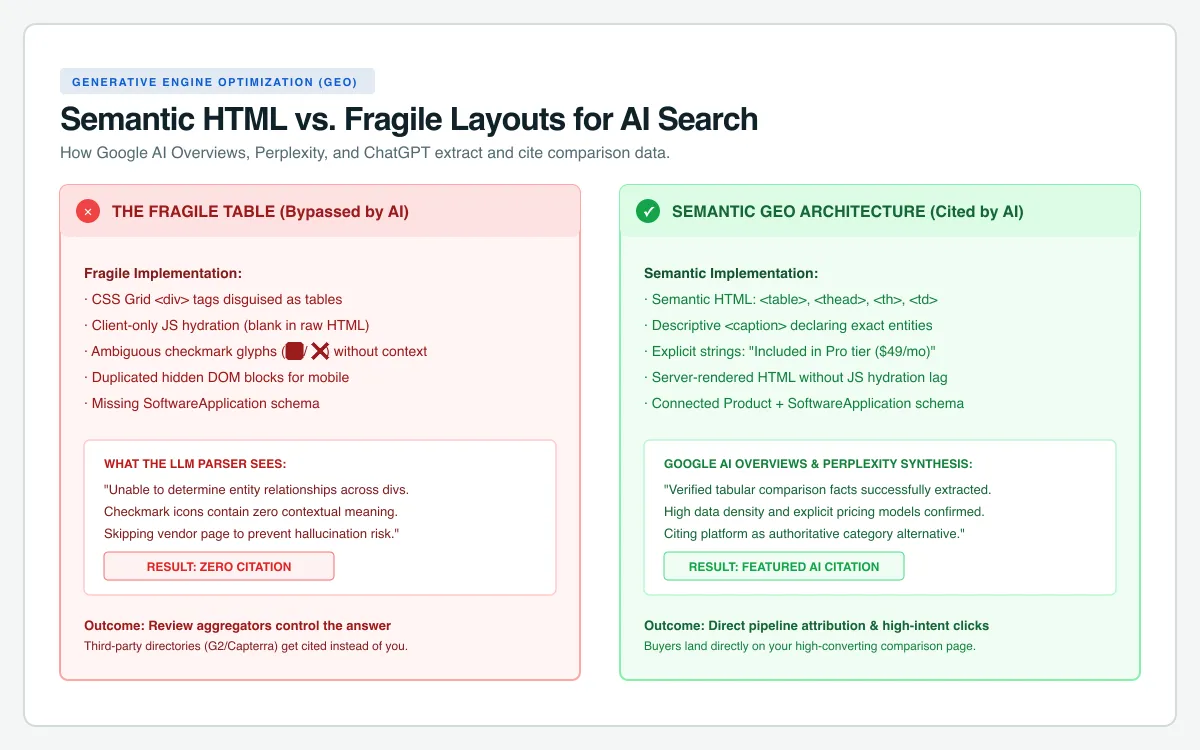
Large language models (LLMs) driving Google AI Overviews, Perplexity, and ChatGPT search features do not parse web pages like human eyes. They ingest structural entity trees.
When an AI engine synthesizes an answer for “What is the best alternative to [Competitor] for small developer teams?”, it pulls heavily from clear HTML tables.
To ensure AI scrapers accurately cite your platform:
- Use valid semantic markup (
<table>,<thead>,<tbody>,<th>,<td>). - Add a descriptive
<caption>explicitly declaring what entities are being evaluated. - Avoid raw checkmark icons. Write explicit strings: “Supported natively”, “Available on Enterprise tier”, “Not supported”. When an LLM extracts a single cell out of context, it must retain semantic meaning.
- Keep table content visible in the initial server-rendered HTML. Avoid client-only hydration scripts that load comparison data seconds after the document request.
Connected JSON-LD Schema Markup
Pair your comparison page with connected structured data that connects the evaluated software entities into Google’s Knowledge Graph:
{
  "@context": "https://schema.org",
  "@graph": [
    {
      "@type": "WebPage",
      "@id": "https://example.com/vs/competitor/#webpage",
      "url": "https://example.com/vs/competitor/",
      "name": "Why Teams Switch from Competitor to Our Product",
      "description": "An objective comparison of features, pricing, and migration workflows."
    },
    {
      "@type": "SoftwareApplication",
      "@id": "https://example.com/#software",
      "name": "Our Product",
      "applicationCategory": "BusinessApplication",
      "operatingSystem": "Cloud",
      "offers": {
        "@type": "Offer",
        "price": "49.00",
        "priceCurrency": "USD"
      }
    },
    {
      "@type": "FAQPage",
      "@id": "https://example.com/vs/competitor/#faq",
      "mainEntity": [
        {
          "@type": "Question",
          "name": "How long does migration from Competitor take?",
          "acceptedAnswer": {
            "@type": "Answer",
            "text": "Most teams complete historical data migration within 48 hours using our native import tools."
          }
        }
      ]
    }
  ]
}
Legal boundaries: nominative fair use and trademark compliance
Marketers frequently ask: “Can a competitor sue us for putting their name on our website?”
In modern commercial jurisprudence, truthful comparative advertising is legally protected. In the United States, the Supreme Court and federal circuit courts uphold comparative advertising under the Nominative Fair Use doctrine. Similarly, in India, Section 30 of the Trade Marks Act (1999) explicitly protects the use of a registered mark in accordance with honest commercial practices.
To ensure your comparison pages remain fully compliant and protected against trademark claims, follow these four rules:
1. Plain Text Word Marks Over Stylized Logos
Use the competitor’s plain-text company or product name (e.g., “Salesforce”, “HubSpot”, “Zendesk”) in your standard body font.
Never use their registered corporate logo, trademarked icon, or stylized brand vector graphics. Using their visual logo exceeds the legal threshold of what is necessary to identify the product and drastically increases the risk of trademark dilution or infringement claims.
2. Maintain an Internal “Substantiation File”
Under FTC comparative advertising guidelines, every objective claim made about a competitor must be substantiable at the time the claim is published.
Create a dedicated internal folder documenting:
- Date-stamped screenshots of the competitor’s public pricing pages.
- Direct links to the competitor’s official documentation or release notes.
- Technical benchmark logs verifying any performance or speed comparisons.
3. Display an Explicit Trademark Disclaimer
Place a clear, readable legal disclaimer directly below your comparison table or in the page footer:
Trademark Disclaimer: [Competitor] is a registered trademark of [Competitor Inc.]. [Your Brand] has no affiliation with, sponsorship from, or endorsement by [Competitor Inc.]. All product specifications, pricing, and feature comparisons are gathered from publicly accessible documentation as of [Last Audit Date] and are subject to change.
4. Establish a Quarterly Review Cadence
Assign an editorial owner to audit your comparison pages every 90 days. If a competitor lowers their prices, releases a missing capability, or updates their branding, update your page immediately. Maintaining fresh, accurate data protects both your legal defense and your commercial credibility.
Review your comparison page before launch
Use this interactive checklist to review your comparison page across positioning, copywriting, technical SEO, and legal compliance before publishing.
0 of 18 checks complete
Completion records your review; it is not an automated audit.
Turn search evaluations into paying customers
A high-converting comparison page does not happen by accident. It is a precise intersection of bottom-of-funnel search intent, rigorous conversion architecture, and honest positioning that respects the intelligence of modern software buyers.
If your team is building or scaling a software marketing website, explore how we approach B2B SaaS SEO and SaaS Web Design at Modern X Webs. We engineer digital platforms that combine architectural speed, structured search discovery, and conversion journeys that turn evaluation traffic into measurable pipeline revenue.
COMMON QUESTIONS
Frequently asked questions.
Will creating a competitor comparison page trigger legal action or trademark lawsuits?
Truthful, non-deceptive comparative advertising is legally protected under the doctrine of Nominative Fair Use in the United States and Section 30 of the Trade Marks Act in India, provided you adhere to honest commercial practices. To stay protected, use the competitor’s plain-text word mark rather than their stylized logo, maintain an internal substantiation file verifying every claim, avoid defamatory or mocking language, and include a clear, prominent disclaimer stating you are not affiliated with or endorsed by the trademark owner.
Should an early-stage SaaS build comparison pages if its own brand search volume is low?
Yes. Early-stage software startups should prioritize "[Competitor] alternatives" and "Best [Competitor] alternatives for [niche]" rather than "[Our Brand] vs [Competitor]". This allows you to borrow existing search demand from market incumbents whose buyers are experiencing pricing shocks, feature bloat, or poor customer support. Once your brand generates consistent search volume, you can layer on direct head-to-head comparison pages.
Do competitor comparison pages cause keyword cannibalization with our core product pages?
No, because they serve fundamentally different search intents. Your core product or feature pages target solution-aware searches (e.g., "customer analytics platform"), whereas comparison and alternatives pages target vendor-aware, bottom-of-funnel queries (e.g., "Mixpanel alternatives"). To maintain clear indexing boundaries, give every comparison page a self-referencing canonical tag, place them in a dedicated folder (/vs/ or /alternatives/), and link to them contextually from pricing or footer menus.
How does Google AI Overviews and Perplexity extract data from comparison tables?
Generative AI engines parse tables structurally rather than visually. CSS grids or JavaScript-rendered div cards often fail AI extraction. To ensure extraction, use semantic HTML table elements (table, thead, th, td, caption), provide descriptive row headers, and avoid ambiguous shorthand like single checkmarks. Instead, write self-contained cell context such as "Included in Base Plan" or "Requires Enterprise Add-on". Pairing the table with SoftwareApplication and Product schema gives LLMs machine-readable facts to ground their citations.
Should I publish competitor pricing if they hide it behind a "Contact Sales" wall?
Only if you have verified, documented proof from publicly accessible sources, such as published procurement reports, press releases, or official documentation. Never publish unverified hearsay or leaked private quotes. If a competitor hides pricing, use that opacity as a strategic contrast by highlighting your own transparent, predictable pricing tiers alongside an honest note stating "Competitor pricing requires custom enterprise sales quotation as of [Audit Date]".
What is a realistic conversion rate for a B2B SaaS comparison page?
While top-of-funnel educational blog posts typically convert between 0.5% and 2%, well-architected bottom-of-funnel comparison pages routinely convert between 5% and 10% of qualified organic visitors. Prospects searching for alternatives or comparisons have already secured budget, identified an operational pain, and shortlisted candidates. Your page’s role is friction reduction and validation, not general market education.
THE RESEARCH BEHIND THE ARTICLE
Sources & methodology.
Recommendations in this guide are synthesized from Modern X Webs’ B2B SaaS SEO client engagements, analysis of high-performing competitor comparison pages across top-tier software companies, Google Search Central technical documentation, and U.S./international comparative advertising legal precedents. Examples and wireframe structures are illustrative models tested for search extractability and conversion.
Browse all 6 references
- Statement of Policy on Comparative AdvertisingFederal Trade Commission
- Creating helpful, reliable, people-first contentGoogle Search Central
- SoftwareApplication Structured DataSchema.org
- HTML Tables TutorialW3C Web Accessibility Initiative
- Nominative Fair Use Trademark DoctrineLegal Information Institute, Cornell Law School
- Optimizing Core Web Vitals for Landing Pagesweb.dev